Eastbourne is a Victorian resort that still runs on a Victorian calendar. The seafront fills when England has a holiday. The Downs behind it do not fill in the same way, or on the same days. A week at Easter and a week in late September can look like two different towns, a bus ride apart.
Festival dates move. Use Visit Eastbourne and the Devonshire Park diary for those. This page is about pressure, light, and which stretch of front to stand on.
Come in May, June or September if you want the promenade, a table, and a walk on the chalk without sharing every bench. Come at Easter and in August only on purpose — the front will be doing what it was built to do, which is hold a great many people, and mid-August is Airbourne. Come in winter for the empty hotel crescent and a walk that costs nothing. Pack a waterproof in every month. Eastbourne’s sunshine totals are genuine; so is a wet Tuesday in July.
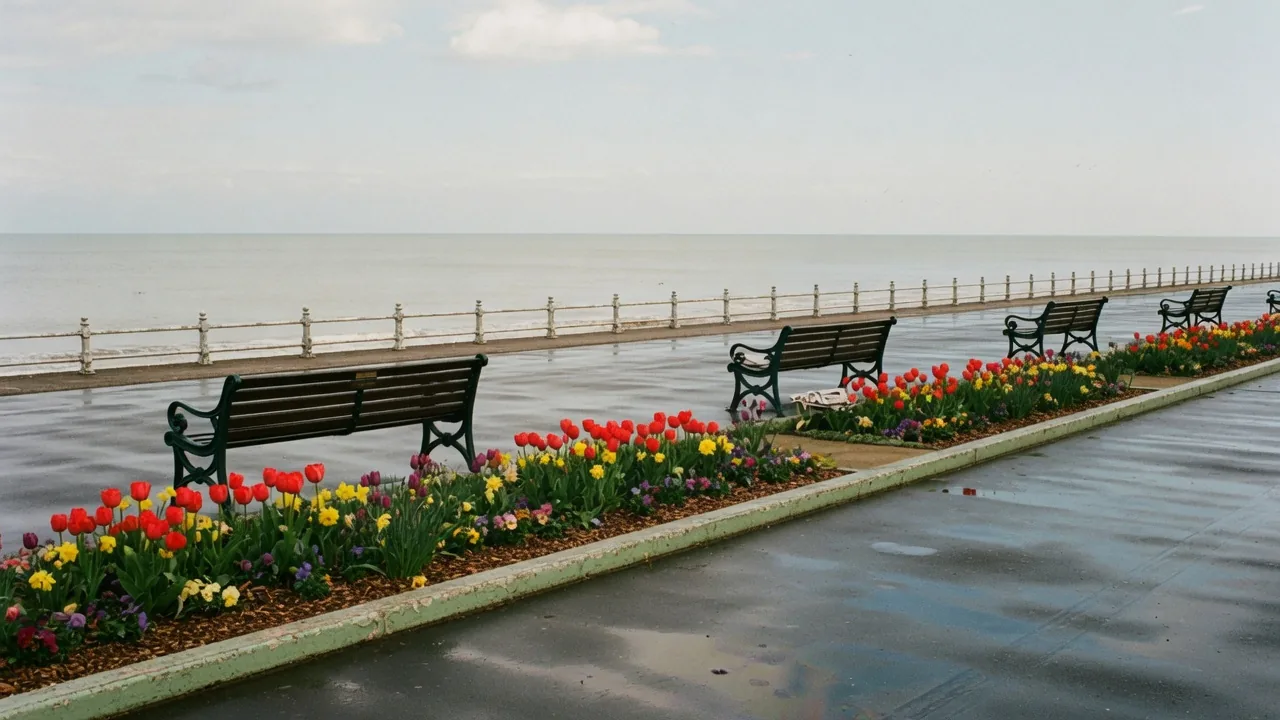
This is the first week the town remembers what it is. Hotels that ran on a skeleton through February fill. The kiosks reappear as the weather allows. The Carpet Gardens, opposite the pier, put on the spring bedding — tulips in the formal Victorian manner, replanted on a twice-yearly cycle — and are the reason Eastbourne wins seaside-in-bloom awards with monotonous regularity. Walk them in the morning, before the day visitors arrive.
The promenade itself is the other spring argument. Six kilometres, Sovereign Harbour to Holywell, level and surfaced, with the Downs rising at the western end. Princes Park on the eastern side is in leaf and not yet a school-holiday playground. Towner Eastbourne is free, indoors, and the right hour on a sharp April day.
Easter is not shoulder season. A fine Easter Sunday on Grand Parade is a crowd. If your dates are Easter because the children are off, treat the pier as the afternoon and a walk west from Holywell, or an hour in Princes Park, as the morning.
Set back from the western seafront, Devonshire Park is the town’s cultural and sporting quarter: three restored theatres, Towner, and the lawn tennis club. Each June it hosts the pre-Wimbledon grass-court week that has been the town’s sporting fixture for decades. The name on the trophy, the draw and the exact dates move. Check the Devonshire Park diary rather than a championship title copied from last year.
What does not move is the effect. That week transforms the western end of town. Accommodation and restaurants go early. Devonshire Park car park is for the tennis, not for a casual gallery visit you could do in May. If you came for the tennis, book the bed first. If you did not, the rest of Eastbourne is still there — the east end, the Old Town, a bus to the cliffs — and it is quieter than the posters suggest, because everyone else is in the Park.
August is the point of a Victorian resort. Families, coaches, day-trippers, and everyone who thinks the British seaside is a summer destination arrive together and walk the same stretch of front. The pier is the thing they walk to. The hotels are full. A table at seven needs a booking.
Mid-August makes it something else. Airbourne in 2026 is Thursday 13 to Sunday 16 August: four days of flying over the sea, free to watch from anywhere along the front, with the Western Lawns as the ground site. Flying runs roughly from lunch through to 5pm; the day’s order sits on the airshow programme, not here. Fireworks some evenings. The Red Arrows withdrew from 2026 after a delayed North America tour. Do not come expecting them, and do not write them into a child’s day as a promise.
Two practical consequences. It is genuinely spectacular and it costs nothing from the promenade. And the town is completely full — beds go months ahead, and driving anywhere near the seafront those days is a poor idea. Pre-book show parking or, better, take the train. The parking guide is the operational document; this page is only saying August is not a circling month.
Get up early. Walk the front at eight. Put Princes Park or a bus to Seven Sisters Country Park in the middle of the day, and come back for the flying if that is why you came.
The Downs are why a lot of people should have come in a different month.
May and June are the best walking months on the chalk: downland flowers, skylarks, long evenings, and a town that is open without being August. The climb from Holywell onto Beachy Head, the clifftop to Birling Gap, the Sisters themselves, the flat walk down the Cuckmere from Exceat — all of it is at its best before the school holidays, and again when they have gone. Our walks guide and cliffs guide are the routes; this page is only the calendar under them.
September is the month to pick if you can move a date. School has gone back. The light goes low and gold along the hotel front. The sea is as warm as it gets. You can park. You can get a table. The clifftop has the first of the autumn in it without the winter wind shutting the day down at four. Days shorten. By the end of the month you want to be off Beachy Head with a margin of daylight. Waterproofs stay in the bag. The crowds do not.
July sits between the two. Busy from mid-month on Grand Parade, bookable, and the month inland visitors think of as peak Eastbourne. It is not Airbourne, and it is not May.
October half-term is a spike, not an August. The town fills for a week and empties again. Vineyards on the Downs do the harvest; the day trips page is the rest of that outing.
On the cliffs, migrating birds move along the coast and Beachy Head is a known watch point. The Sisters in a clear October are the photograph a lot of August people think they took. Low sun, fewer people, a wind you should take seriously.
November is the start of the winter town: theatres, Towner, the Cornfield restaurants, and a seafront that has stopped performing.
Winter is when the Devonshire estate seafront earns the rest of the year. The kiosks shut. The bandstand is closed or running a limited programme — check rather than counting on a concert copied from July. What remains is the thing the seventh Duke actually built: kilometres of promenade, the pier to walk, hotels lit along the front, and, on a clear frost, the Downs white above Holywell.
It is the best walking season on the six-kilometre promenade and the worst for daylight and kiosk hours. A bright January morning on Eastbourne Pier, with no one on it, is the visit a lot of Airbourne crowds think they had. Christmas to New Year is the winter version of an Airbourne-scale spike: fewer kiosks, fuller car parks, Grand Parade busy at lunchtime. A midweek in February is not.
The town does not close. Towner stays open. The theatres carry the wet afternoons. The rain guide applies in January as much as in July, and a Victorian front in a squall is a genuine pleasure, which is why the shelters were put there.
The national trail starts — or finishes — in Eastbourne. People walk in from Winchester through every month there is daylight enough, and the last (or first) stretch is the one that drops off the chalk into a working seaside town. There is a coastal line over the Sisters and an inland line over the tops; they rejoin at Alfriston. Neither of them cares what the bandstand is doing.
If you are here to finish the Way, the month is less important than the wind and the light. Winter needs an early start and a bed you can walk to from the station. Summer needs a booking. May, June and September are the months the trail would choose. The walks guide picks the route up; getting here is the train.
May for the Carpet Gardens, the Downs in flower, and a town that still has room. June for the evenings, and for tennis only if that is the trip. September for the year in miniature — light on the front, the Sisters to yourself at tea-time, a table in the Cornfield quarter. January for the promenade and the pier, if you can live without the bandstand.
Easter and August on purpose, with an east-end afternoon in the plan and a bed already paid for. Airbourne as its own holiday, not as a surprise in the middle of a quiet week. Half-terms as small versions of the same, not as quiet windows.
Eastbourne does not close. The front gets full, the weather comes in, or both. The Downs and the east end are why that is survivable. Pick the month that matches the trip you actually want, not the month the rest of the south-east is also free.