Princes Park is the east-end counterweight to the Victorian pier and bandstand. While Grand Parade performs being a resort, this is where Eastbourne actually sits on the grass. It is a proper municipal park of the traditional kind — free, open, well used by residents, and largely off the day-tripper route — and on a summer afternoon when the pier is shoulder to shoulder, the park has space.
It sits on the inland side of Royal Parade, about 1.75 kilometres north-east of the pier, postcode BN22 7AE. The attraction page covers the facts. This is how to use it for a morning, a half day, or the family afternoon that the western seafront does not know it is missing.
The first confusion to kill. Devonshire Park is the tennis and theatre quarter, inland from the western seafront, with Towner Eastbourne and the Congress Theatre in it. Princes Park is the eastern park, behind the beach, with a lake in it. They are not adjacent. They are not substitutes. If the satnav says Devonshire and the children were promised a playground by the water, you have gone to the wrong century of Eastbourne.
The western front is hotels, Carpet Gardens, the 1935 bandstand. This is lawns, a boating lake, two playgrounds and a large field. Both are free. They do different jobs. Our seafront piece is the other walk.
The ground was the Crumbles: an expanse of storm-beach shingle between the high-water mark and the marshes inland, with a lagoon on it that maps have called Crumble Pond since at least the seventeenth century. In 1908 the landowner leased roughly eleven hectares to the corporation as a recreation ground. Unemployed men of the town covered the shingle with ballast and soil. It was Gilbert Recreation Ground until June 1931, when the Prince of Wales planted an evergreen oak and the park took his title.
What you walk through now is that made ground. The lake is the old pond, formalised and edged in the 1920s. The whole park is about 13 hectares, 33 acres. It is still underlain by shingle. It is still a public park rather than a ticketed attraction, which is the point.
Crumbles Pond, the boating lake, gives the park its shape. A circuit of it is the walk most people do: wildfowl through the year, model boats from the clubs that have used the water since the 1920s, and enough bench to sit without negotiating. Coarse fishing is permitted with the appropriate permit.
The lake is not a lido and not a marina. Pedalos of the old sort have come and gone; do not count on a boat for hire on the day you arrive. What you can count on is the water, and the fact that children will run the edge of it.
Buzz Active sits across Royal Parade, not inside the park, and runs paddleboard, canoe and beginner windsurf sessions on the lake. That is an operator, with operator hours. Check before you build a morning around a lesson. The park itself does not take a booking.
The circuit is level and surfaced. The circuit of Crumbles Pond is the level loop most visitors walk, and it is the stretch of Princes Park that works with a pushchair or a wheelchair. The interior is vehicle-free, which is why it feels larger than 33 acres.
Two children’s playgrounds, one with a paddling pool in summer. The zip slide is the piece of equipment children make for first. The play tops out around twelve; older children use the field, the putting, or the football.
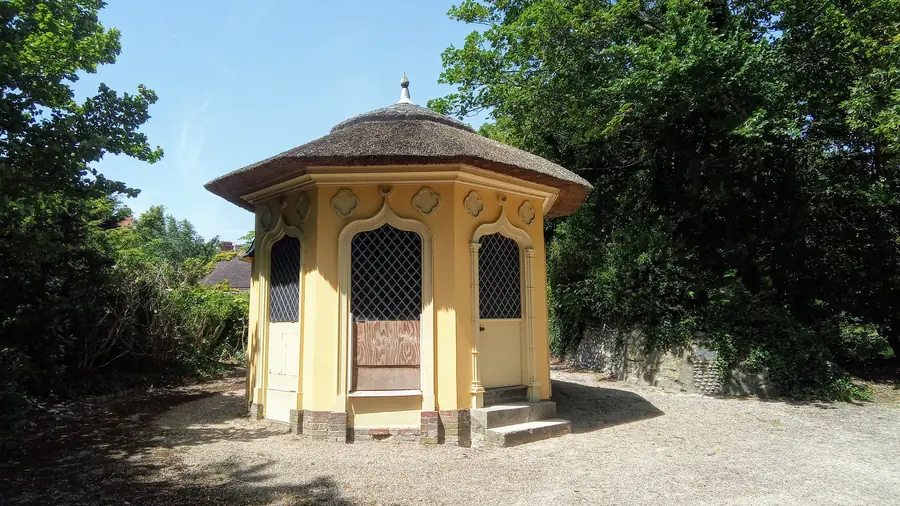
The rose garden is scented and formal, and it is the quietest corner of a park that is already quieter than the front. Give it ten minutes. The thatched summerhouse is the photograph, and a reason to walk the garden rather than only the lake.
On the east side, a large field takes travelling funfairs and circuses several times a year, and is otherwise grass. The Oval inside the park is a football ground, home of Eastbourne United. On match days the feel of that corner changes; on every other day it is a fence around a pitch.
Wildlife uses the lake and the scruffier edges. It is not a nature reserve, and it is not only a playground. The mix is what a 1930s municipal park was for.
Mini golf and a café sit toward the east side, with toilets adjacent. The café is seasonal in the way seaside park cafés are seasonal: daily in the main season, thinner at the ends of the year, shut or on a kettle when you most wanted it in February. Confirm rather than counting on a full menu. There is usually an ice cream when the park is busy.
The putting green is an 18-hole leftover of the English seaside, the sort of thing that has vanished from most towns and is still here. None of this is why you come. It is why a family stays for three hours instead of one.
The park itself does not close. The paid bits do.
Park at Princes Park / Fort Fun car park, opposite, Royal Parade BN22 7LQ. Pay and display, 149 spaces, 10-hour maximum, 8am–8pm every day including bank holidays, 2-metre height barrier. It shares a tariff band with the Beachy Head cluster; the board is the price. Details in the parking guide.
Do not park on Grand Parade and drive round. Do not use the Wish Tower for this. The park is the east end.
Seafront buses stop nearby. Eastbourne station is about two miles west — a walk along the promenade if that is the day, a short bus if it is not. The interior of the park is vehicle-free; once you are through the gate, the car has done its job.
Wheelchair users get surfaced paths around most of the park. The lake circuit is the reliable one. Toilets are by the café.
Indoor soft play sits next door on Royal Parade, a different operator and a different day. Visit Eastbourne has listed it Wednesday to Sunday, 10am–6pm; hours have tightened and shifted around that snapshot, including weekend-only spells. Check the operator before you promise it. Treasure Island, further along Royal Parade, is the sister outdoor/indoor mix and a different queue.
Fort Fun is why some families park in the Princes Park car park and never cross the road. That is their loss. The park is the better half of the same stop, it costs nothing, and it is the thing children remember if you let them run.
Princes Park is the start of an east-end day, not a detour from the pier.
The eastern promenade runs past the Redoubt and on toward Sovereign Harbour: quieter beach, groynes, the fishermen’s stores, then the marina and the waterfront restaurants four kilometres from the centre. Walk it after the park. The seafront piece picks the route up.
E.M.S.R. Adventure Park, the miniature railway, is a short way north and the local family secret. The Sovereign Centre swimming complex is the wet-weather option in this corner. Neither is inside the park.
A full east-end afternoon: park once, lake and playgrounds, mini golf if it is open, ice cream, then the promenade toward the harbour or back toward the Redoubt. That is the family day our with kids guide is pointing at when it sends you east.
A weekday in May or September for the park as a park: roses, an empty circuit, the summerhouse to yourself. A school-holiday afternoon if the playgrounds are the point — it still will not feel like the pier. A match day at the Oval only if you meant that.
Drizzle suits the lake. The field is a different proposition in it. See Eastbourne in the rain.
A gale is the rose garden and the café, if the café is open. The eastern end is exposed to the sea wind.
Winter is trees, water, and a kettle that may be off. It is still free, and it is still better than a shuttered kiosk on Grand Parade.
Give it an hour to walk the lake. Give it two or three with children and the playgrounds. Give it a half day if the east-end promenade is the rest of the plan. Then walk west to the pier, or east to the harbour, and remember that the Victorian seafront is only half the town.