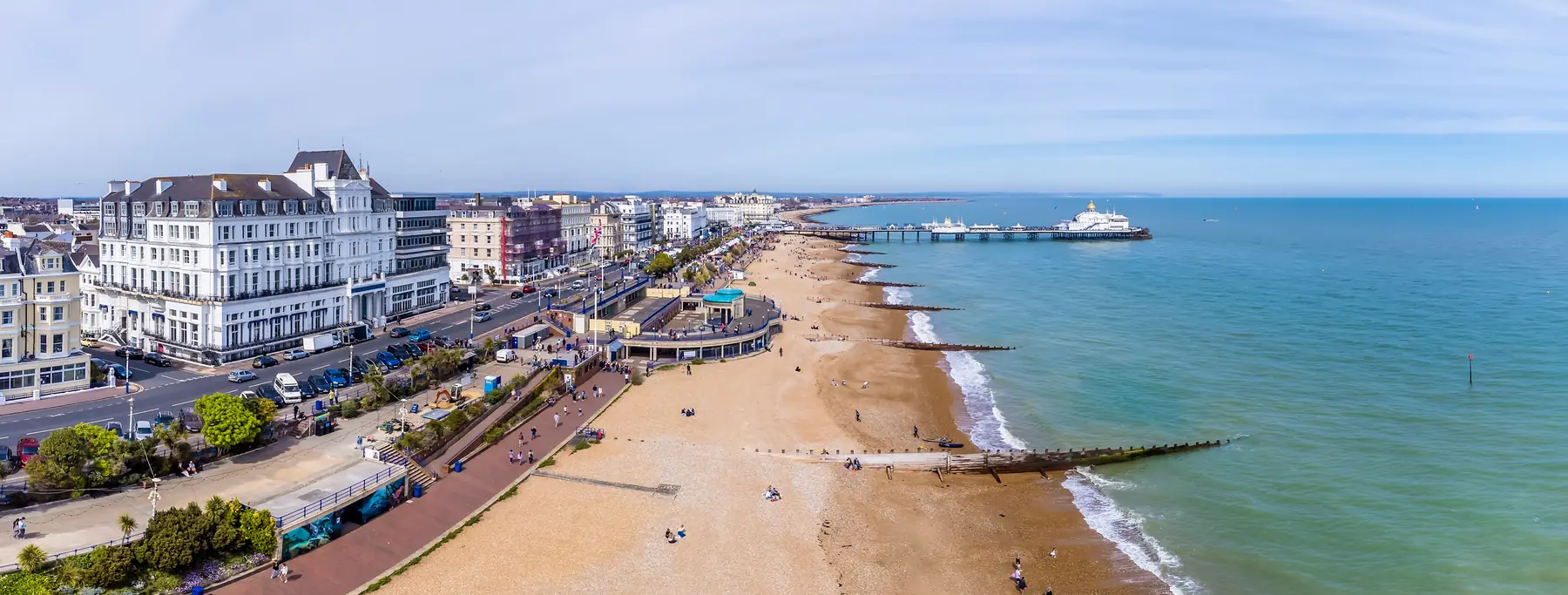
Eastbourne sits at the eastern end of the South Downs with the Sussex coast running away in both directions, and the railway makes almost all of it easy. Brighton is under forty minutes west, Hastings about half an hour east, Lewes twenty minutes north, and the Marshlink line carries on to Rye and Ashford International. You can have a genuinely varied week here without ever getting in a car.
Thirty-one kilometres west and under forty minutes by direct train. The Royal Pavilion, the Lanes, the museums, the pier, the seafront and a food and nightlife scene of a completely different order from Eastbourne’s. It is the obvious contrast day, and the train drops you five minutes from the sea.
Thirteen kilometres west, on the same line. A quieter town with a long shingle beach and, on the headland above it, the nature reserve that gives the classic view back across the Cuckmere to the Seven Sisters. Combine it with a walk.
Twenty-five kilometres north-west, twenty minutes by train. The county town of East Sussex: a Norman castle, Anne of Cleves House, steep lanes of flint and brick, the Harvey’s brewery, and an unusual density of bookshops and pubs. The Bonfire celebrations on 5 November are the most extraordinary in the country and are not a casual visit.
Around eighteen kilometres north-west near Glynde. Glyndebourne is the country-house opera festival, one of the most celebrated in the world, held from May to August with a long dinner interval on the lawns. Firle Place and Glynde Place are both country houses open seasonally, and the Downs above them are superb walking.
Fifteen kilometres east. The De La Warr Pavilion on the seafront is a 1935 modernist masterpiece — one of the first major modernist public buildings in Britain — now an arts centre with free galleries, a café and a terrace over the sea. Bexhill itself is quiet and old-fashioned, and the museum has a good motoring collection: Britain’s first motor race was run here in 1902.
Twenty-eight kilometres east, half an hour by train. The Old Town below the East Hill, the net shops on the beach, the fishing fleet launched off the shingle, two funicular railways, the caves under the West Hill and a castle above. It is scruffier and more interesting than Eastbourne, and the Old Town is the best afternoon on this coast.
Twenty-two kilometres north-east. Battle Abbey stands on the site of the Battle of Hastings, with the battlefield laid out below and an English Heritage exhibition explaining what happened where. Standing on the ground is the thing; the audio tour does the rest. The town itself is a good high street with pubs and antique shops.
Around forty-five kilometres east, on the Marshlink line via Hastings. A hill town of cobbled streets and timber buildings that was a Cinque Port until the sea retreated, leaving it two miles inland. Small, extremely photogenic and best in the early morning or the evening.
Ten kilometres north-west. A village of flint and timber on the Cuckmere, with a market cross, the Star Inn, the church known as the Cathedral of the Downs, and the Clergy House — the first building the National Trust ever bought, in 1896. Drusillas Park is on the same road.
Ten kilometres north-west. A seventy-metre chalk figure on the hillside above Wilmington, with a priory ruin in the village and a short steep walk up to the ridge.
Twelve kilometres north. A fifteenth-century moated brick castle beside the Observatory Science Centre, in the domes of the former Royal Greenwich Observatory. The two together make a full day, and it is the best bad-weather option in the area.
The chalk under the South Downs is the same geology as Champagne, and East Sussex now produces some of the best sparkling wine in the world. Several producers within half an hour of Eastbourne run tours and tastings, and a vineyard afternoon is one of the more civilised ways to spend a day here.
Ashford International is on the Marshlink line, which means Eurostar and, at a stretch, France. Canterbury is around two hours. London is an hour and a half from the station in the middle of town, which makes a day in the capital entirely practical.
Eastbourne is one of the better-connected south coast towns. The station is 100 metres from the town centre on Terminus Road, with direct Southern services to London Victoria in around an hour and a half — up to two an hour, and around sixty-seven trains a day on weekdays, though far fewer on Sundays. Brighton is under forty minutes direct. Gatwick Airport is on the same line, around an hour. Eastward, the Marshlink line runs to Bexhill, Hastings, Rye and Ashford International.
Direct trains to London Bridge exist but are a token service — for London, plan on Victoria.
Buses cover the cliffs, Birling Gap, Alfriston, Seaford and Pevensey, with an open-top service along the coast road in summer. The getting here page covers the trains and the coast services.
The coast day, no car. Train west to Seaford, walk up onto Seaford Head for the classic view of the Seven Sisters, drop down to the Cuckmere and follow the valley to Exceat, then bus back along the cliff road via Birling Gap and Beachy Head. Three of the best viewpoints in Sussex and no driving.
The 1066 day. Train east to Battle for the abbey and the battlefield in the morning, on to Hastings for the Old Town, the net shops and the funiculars in the afternoon, and back along the coast. The whole Norman conquest in one day, ending where William actually landed if you stop at Pevensey.
The Downs and villages day. North-west by car or bus to Wilmington for the Long Man, on to Alfriston for the Clergy House and lunch, then Drusillas or the Cuckmere valley in the afternoon, returning via Jevington or East Dean. Slow lanes, flint villages and the best pub stops in the area.
The Sussex coast is busy in August and at half terms, and Brighton is busy most weekends. Two Eastbourne-specific dates matter: Airbourne in mid-August, when the town is completely full, and the tennis at Devonshire Park in June. Both are excellent reasons to visit and terrible weeks in which to arrive without a booking.
Out of season, the trains are quieter, the cliffs are empty and the town is at its most likeable.
The train covers the coast and the trains are good, but two of the best trips here are bus journeys in their own right. The open-top service along the cliff road in summer runs from the seafront up over Beachy Head, past Belle Tout to Birling Gap and East Dean, and the ride is worth the fare regardless of where you get off. And the service up the Cuckmere valley to Alfriston and Seaford takes you through the flint villages at the pace they deserve.
Both accept the standard day tickets, which makes a bus-based day out here unusually good value compared with driving and paying for the clifftop car parks.
Lewes or Hastings for a half day, Brighton for a full one, Battle if you want the history.
Thirty-one kilometres west, under forty minutes by direct train.
Yes, on the Marshlink line with a change at Hastings.
The opera festival runs from May to August and tickets go quickly; the gardens open to ticket holders.
Around an hour and a half to London Victoria, direct, up to twice an hour.