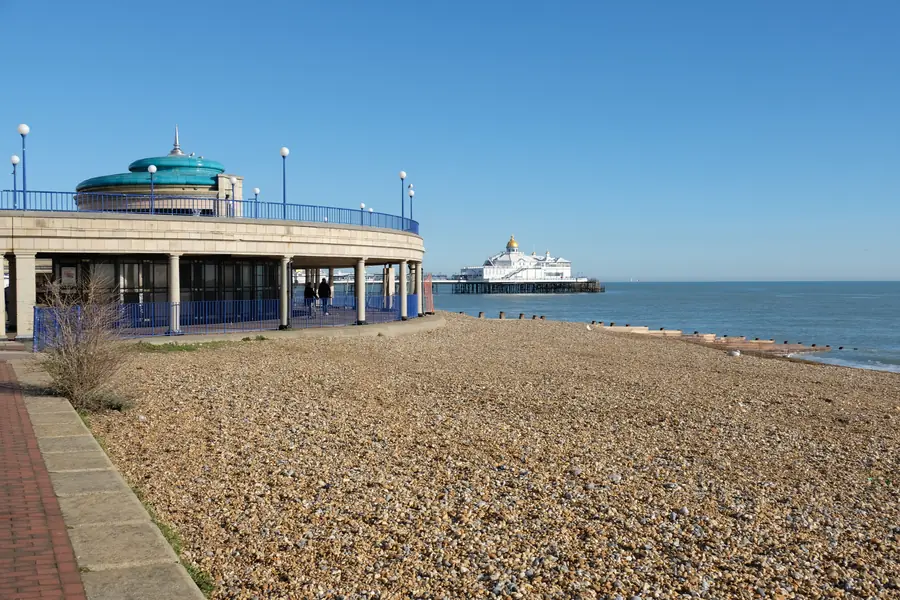
Eastbourne Pier runs 300 metres out from Grand Parade in the middle of the seafront, and it is one of the best-preserved Victorian pleasure piers in Britain — Grade II* listed, opened in 1870, designed by Eugenius Birch, the engineer responsible for more of England’s piers than anyone else.
It is free to walk on, open most of the year, and it is where Eastbourne’s seafront resolves itself.
Birch built it on a system of screw piles driven into the seabed, with the deck resting on cups rather than being rigidly fixed — a design intended to let the structure move in a storm rather than break.
It was tested almost immediately. In 1877 a storm took away the landward half, which was rebuilt at a higher level; the resulting kink in the deck profile is still visible and is a feature of the pier rather than a fault.
Since then it has survived a 1970 fire that destroyed the ballroom, a Second World War mine placed on the deck by the British as an anti-invasion measure — and detonated, on purpose — and a major fire in 2014 that destroyed the arcade building. Each time it has been rebuilt.
The camera obscura in one of the domes, restored, is one of very few working examples left on a British pier.
Amusement arcade and games, rebuilt after the 2014 fire.
Bars, a tea room and food outlets along the deck, with the domed pavilion at the seaward end.
Fishing from the end platform, which is popular and productive.
The view — back to the seafront and the Victorian hotels, and west along the shore to the great green shoulder of Beachy Head. This is the best place to appreciate the shape of Eastbourne’s front, which is unusually intact: a continuous run of white stucco and terraces with no gap-toothed modern blocks.
Visitors describe it as clean, well kept and family-friendly, which is not universally true of English piers and reflects sustained investment.
A practical warning that comes up constantly and is worth taking seriously: the gulls on and around the pier are bold, and they will take food from your hand.
This is not an exaggeration or an occasional nuisance. Eat inside, or under cover, or well back from the front. It is the single most common piece of advice returning visitors give.
Free to walk on. Individual attractions charge.
Open daily in season; reduced hours in winter and closed in high winds.
Access: the deck is level and boarded and is manageable with a wheelchair or pushchair, though the boards are uneven in places.
Parking: on-street along Grand Parade and in the seafront car parks, and it is busy in summer — visitors regularly mention this.
Time: thirty minutes to walk out and back; longer with a stop.
The bandstand, two minutes west, still hosts concerts through the summer and is one of the last working seaside bandstands in the country.
The Wish Tower, a Martello tower on the front further west.
Towner Eastbourne, the art gallery, is ten minutes inland at Devonshire Park and is free.
The seafront walk west leads to the foot of Beachy Head.
Yes, free to walk on. The arcade, bars and food outlets charge.
It opened in 1870, designed by Eugenius Birch, and is Grade II* listed.
A fire in 2014 destroyed the arcade building; it has been rebuilt. An earlier fire in 1970 destroyed the ballroom.
Yes, from the end platform.
They are genuinely bold and will take food from your hand. Eat under cover or away from the front.