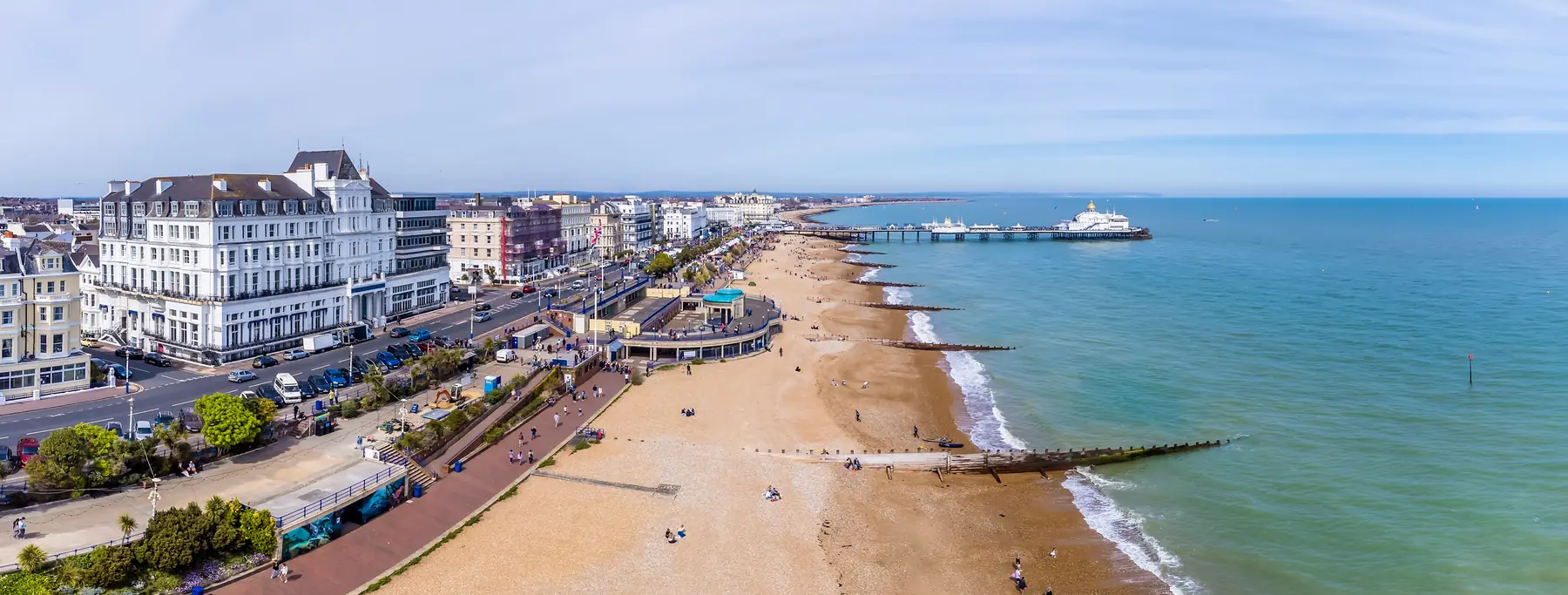
Eastbourne’s seafront is the most unusual on the south coast, and the reason is a single act of estate policy. Most of the frontage has belonged to the Dukes of Devonshire since the town was built, and the estate has consistently refused to let the Victorian buildings along it be converted into shops and amusements. The result is a promenade of hotels, gardens and shelters running for kilometres with almost nothing commercial on it — the exact opposite of Brighton, thirty kilometres west.
Whether you find that genteel or dull depends on what you came for. What is not in doubt is that it has aged extremely well.
Eastbourne Pier opened in the 1870s and is a proper Victorian pleasure pier: iron legs, a wooden deck, domed pavilions and a length of open sea beneath you. It carries an amusement arcade, shops, food, a camera obscura and a good deal of blue and white paintwork.
It has had a hard century. The landward end was destroyed by fire in 2014 and rebuilt; before that a storm took out a section in 1877. It is still standing, still busy, and free to walk onto — the walk out over the water at any time of year is one of the best things to do in the town.
More on our Eastbourne Pier page.
Halfway along the front, the 1935 bandstand is a blue-domed structure with a semicircle of terraced seating around it, and it is one of the last places in England where a seaside town still runs a full programme of seafront concerts through the season. Brass bands, tribute acts, orchestral evenings and firework nights all appear. Tickets are cheap; the deckchairs behind the paying seats are free, and the sound carries.
The Carpet Gardens opposite the pier are formal bedding displays in the Victorian manner, replanted twice a year, and are the reason Eastbourne wins seaside-in-bloom awards with monotonous regularity.
The promenade itself runs on three levels in places and continues for about six kilometres from Sovereign Harbour in the east to Holywell in the west, where it runs out under the cliffs and the Downs begin. It is level, surfaced and lined with shelters and benches, and walking a stretch of it is what most visitors do first.
Eastbourne expected Napoleon, and the evidence is at both ends of the front.
The Wish Tower on the western seafront is Martello tower number 73, one of a chain of squat brick forts built along this coast between 1805 and 1812. It sits in its own gardens on a rise above the promenade.
The Redoubt at the eastern end is a much larger circular fortress, built at the same time as a supply depot and strongpoint for the Martello chain. Opening varies through the year.
Both are visible for nothing and both make sense of a coastline that has been watching for invasions since the Romans built the fort at Pevensey.
Four kilometres east, at the far end of the promenade, the marina development is Eastbourne’s modern seafront: a large yacht harbour, apartment blocks, a waterfront strip of restaurants and bars, and a retail park behind. It is a different town from the Victorian front — newer, flatter, more spread out — and on a warm evening the boardwalk around the boats is a pleasant place to eat.
The beach here and the walk east towards Pevensey Bay are quieter than the town.
Shingle at the top, with sand appearing at low tide along much of the town frontage. It is a clean beach with lifeguards in season, groynes dividing it into bays, and it gets steadily quieter as you go west towards Holywell, which sits under the cliffs and is the nicest stretch.
Mid-August brings Airbourne, the town’s biggest event: four days of flying over the sea, with the Red Arrows a regular fixture, plus ground displays, bands and a very large number of people. It claims to be the biggest free air display on the south coast and the claim stands up.
Two practical consequences. It is genuinely spectacular and it costs nothing to watch from anywhere along the front. And the town is completely full — accommodation goes months ahead and driving anywhere near the seafront on those days is a poor idea.
Set back from the western seafront, Devonshire Park is the town’s cultural and sporting quarter: three restored theatres, the Towner gallery, and the lawn tennis club that hosts the pre-Wimbledon grass-court tournament each June. That week transforms the town — book accommodation and restaurants well ahead if you are visiting then.
The full promenade walk from Sovereign Harbour to Holywell is about six kilometres and takes an hour and a half at an amble. Doing it westwards is better: you finish under the cliffs with the Downs rising in front of you and the option of climbing on towards Beachy Head. Buses run the length of the front if you would rather not walk back.
Our walks guide picks the route up from there, and our cliffs guide covers what happens when the promenade runs out.
Getting there. The station is 100 metres from the town centre and a flat ten-minute walk from the pier.
Parking. Free at the Redoubt and Fishermen’s Green on the eastern seafront and at the Sovereign Park car parks; paid nearer the centre.
Season. The bandstand programme, the seafront kiosks and the open-top bus run through the summer; the promenade itself is a year-round proposition and is at its best on a bright winter day.
Accessibility. The promenade is level and surfaced throughout, and the pier deck is flat.
Eastbourne is a planned town. Until the middle of the nineteenth century there were four scattered settlements here — the Old Town inland around the parish church, a hamlet at Southbourne, a fishing community by the sea, and Meads under the cliffs. What joined them was a deliberate development scheme, begun in the 1850s under the seventh Duke of Devonshire, to build a high-quality resort on the estate’s land.
The railway arrived in 1849 and the town went up quickly, laid out with wide streets, generous squares and a seafront reserved for hotels and gardens. The Duke’s surveyor set the pattern; the estate has enforced it ever since. That is why the front has no arcades, why the buildings are uniform in height and materially consistent, and why Eastbourne looks planned in a way that Brighton and Hastings, which grew, do not.
It also explains the town’s reputation for being genteel and slightly sleepy. That reputation is out of date — the population is over a hundred thousand, the restaurant scene behind the front is genuinely international, and the Towner is a serious gallery — but the seafront is still doing exactly what it was designed to do in 1851.
If you have one hour and want the best of it: start at the Wish Tower on the western section, walk east past the Carpet Gardens to the pier, go out to the end and back, then continue to the bandstand and take one of the deckchairs. That is the Victorian seafront in miniature, it costs nothing except a deckchair, and on a bright day with the band playing and the Downs at your back it is very hard to beat.
The front faces south-east, which has a specific consequence worth knowing: you get sunrise over the sea from the pier and the eastern beaches, and sunset behind the cliffs from Holywell at the western end. Photographers work both ends of the day here. In midsummer, the light on the chalk at Beachy Head in the last hour before sunset is the single best sight in the town, and it is a twenty-minute bus ride from the pier.
Yes, walking onto the pier is free; the arcade, shops and food are not.
Because the Devonshire estate, which owns most of the frontage, has consistently refused to allow the Victorian buildings to be converted into shops and arcades.
Mid-August, over four days. It is free to watch from the seafront.
A Martello tower, one of the chain of small forts built along this coast against a Napoleonic invasion.
About six kilometres from Sovereign Harbour to Holywell, level and surfaced throughout.