Eastbourne surprises people who arrive expecting a genteel seaside town living on afternoon tea. It has a genuinely international restaurant scene for its size — Italian, Turkish, Persian, Thai, Vietnamese — concentrated in a few streets behind the seafront, and it is noticeably better value than Brighton half an hour along the coast.
The town’s shape helps. Almost all the eating is in three places: the streets between the station and the sea, the Old Town fifteen minutes inland, and the waterfront at Sovereign Harbour. Everything else is hotel dining rooms on the front.
The streets between the station and the seafront — Cornfield Terrace, Cornfield Road, Ivy Terrace, Grove Road — hold most of the town’s best restaurants in a few hundred metres.
Pomodoro e Mozzarella and La Locanda Del Duca, both on Cornfield Terrace, are the two Italians that Eastbourne argues about, and Rossi’s on Cornfield Road makes it three. Thai and Vietnamese Street Food on Ivy Terrace and Gạo Vietnamese Cuisine cover south-east Asia. Tehran on Grove Road does Persian cooking and has one of the strongest local followings in the town.
Around the corner, Meze on Pevensey Road and Turkuaz on Upperton Road are the Turkish restaurants, and between them they explain a lot about how Eastbourne actually eats.
Fifteen minutes inland is the village Eastbourne was before the resort was built, and it has kept its own pubs and restaurants. The Two Bulls Steakhouse on Church Street is the name to know. The Old Town pubs are the closest thing Eastbourne has to a proper local scene, and they are a very different proposition from the seafront.
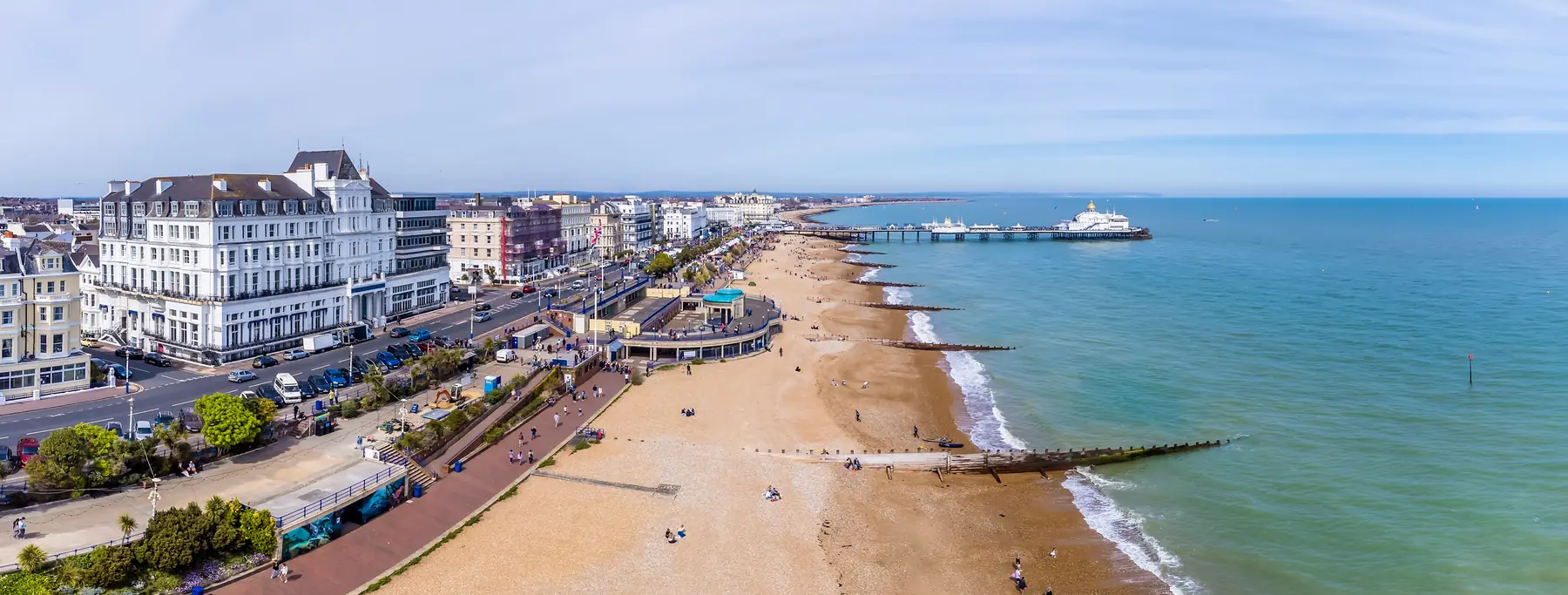
Eastbourne’s promenade is Victorian hotels rather than restaurants, by design — the Devonshire estate would not allow the frontage to be converted to shops, which is why the town looks as it does.
That means the seafront dining is largely hotel dining, and some of it is excellent. The Grand Hotel on King Edward’s Parade is the town’s landmark, a vast white Victorian pile with a formal restaurant and a long-standing reputation. The Hydro, the Lansdowne, the Langham and the View all have dining rooms open to non-residents. Afternoon tea at the Grand is the traditional Eastbourne indulgence.
At the pier and along Royal Parade, the seafront cafés and the fish and chip shops handle everything else.
Four kilometres east, the marina development has a waterfront strip of restaurants and bars looking over the boats. It is a different atmosphere from the town — newer, more spread out, better on a warm evening — and there is parking, which the centre does not always have.
Eastbourne’s pub geography splits between the Old Town, which has the traditional ones, the streets behind the seafront, which have the busier ones, and the surrounding villages, which have the best ones. Alfriston, Wilmington, Jevington and East Dean all have village pubs within fifteen kilometres that are worth the drive, and East Dean in particular is a standard finish to a Seven Sisters walk.
Harvey’s of Lewes is the local brewery and its bitter is on across the county.
Sussex does well out of the sea and the Downs. Local fish — plaice, sole, mackerel, and crab and lobster from the small boats — appears on menus along this coast. Romney Marsh and South Downs lamb are the local meats. And East Sussex is now serious wine country: the chalk of the Downs is the same geology as Champagne, and several of England’s best sparkling wine producers are within half an hour of the town, with vineyard tours and tastings.
The seafront has the traditional version, the Towner has a good gallery café, and the streets behind the station have the independent coffee shops. Beachy Head and Birling Gap both have cafés with views that no town-centre site can match — the Birling Gap one is National Trust and gets very busy on summer weekends.
Booking. Eastbourne fills in August, and completely during Airbourne, the free air display in mid-August. It also fills during the tennis at Devonshire Park in June, when the town hosts the pre-Wimbledon grass-court tournament. Book well ahead for both.
Out of season. A number of independents reduce hours in winter, and the seasonal seafront places close entirely. The Cornfield quarter restaurants stay open year-round.
Getting there. The restaurant streets are a five-minute walk from the station, which makes an evening out here easy without a car.
Dogs are widely welcome, and the seafront and the Downs make Eastbourne a popular dog-walking destination.
Breakfast in one of the independents behind the station. Coffee at the Towner, which has one of the better gallery cafés on the coast. Lunch at Birling Gap or Beachy Head if you are walking, or in the Old Town if you are not. Afternoon tea at the Grand, which is the traditional Eastbourne indulgence and worth doing once. Dinner in the Cornfield quarter — Italian, Turkish or Persian, whichever you feel like — and a last drink in an Old Town pub.
The whole circuit except the cliffs is inside a twenty-minute walk, which is one of the practical pleasures of a town this size.
Better than the town’s traditional reputation suggests. The Turkish and Persian restaurants handle vegetarian eating as a matter of course rather than as an afterthought, the south-east Asian places have substantial meat-free menus, and the Italians on Cornfield Terrace cater properly. The seafront cafés and the hotel dining rooms are the weakest link, as they tend to be everywhere.
Coming off the Downs, three options. East Dean, at the top of the hill behind Birling Gap, has a village green with a pub on it and is the standard finish to a Seven Sisters walk. Alfriston, at the northern end of the Cuckmere valley, has several. And Holywell, where the promenade meets the cliffs at the western end of Eastbourne, has a café at the point where most cliff walks come back down into the town.
Eastbourne’s restaurant supply is fixed and its visitor numbers are not. Two weeks in particular transform the town. The tennis at Devonshire Park in June, the main pre-Wimbledon grass-court tournament, fills the hotels and the restaurants for a week. Airbourne, the free air display in mid-August, fills everything for four days and makes driving near the front pointless.
Outside those, August and the school holidays are busy but manageable, and the shoulder months of May, June and September are the best time to eat here — everything is open, nothing is full, and the seafront is at its most pleasant.
In winter a number of the seasonal seafront places close entirely, but the Cornfield quarter restaurants, the Old Town pubs and the hotel dining rooms all run year-round.
Cornfield Terrace and the surrounding streets between the station and the seafront.
The seafront hotels, the pier and the cafés along Royal Parade in town; Birling Gap and Beachy Head for the cliffs.
The Old Town pubs, the Turkish and Persian restaurants behind the seafront, and the village pubs at East Dean and Alfriston.
Noticeably, for comparable cooking.
In August, during Airbourne and during the tennis in June, yes — well ahead.