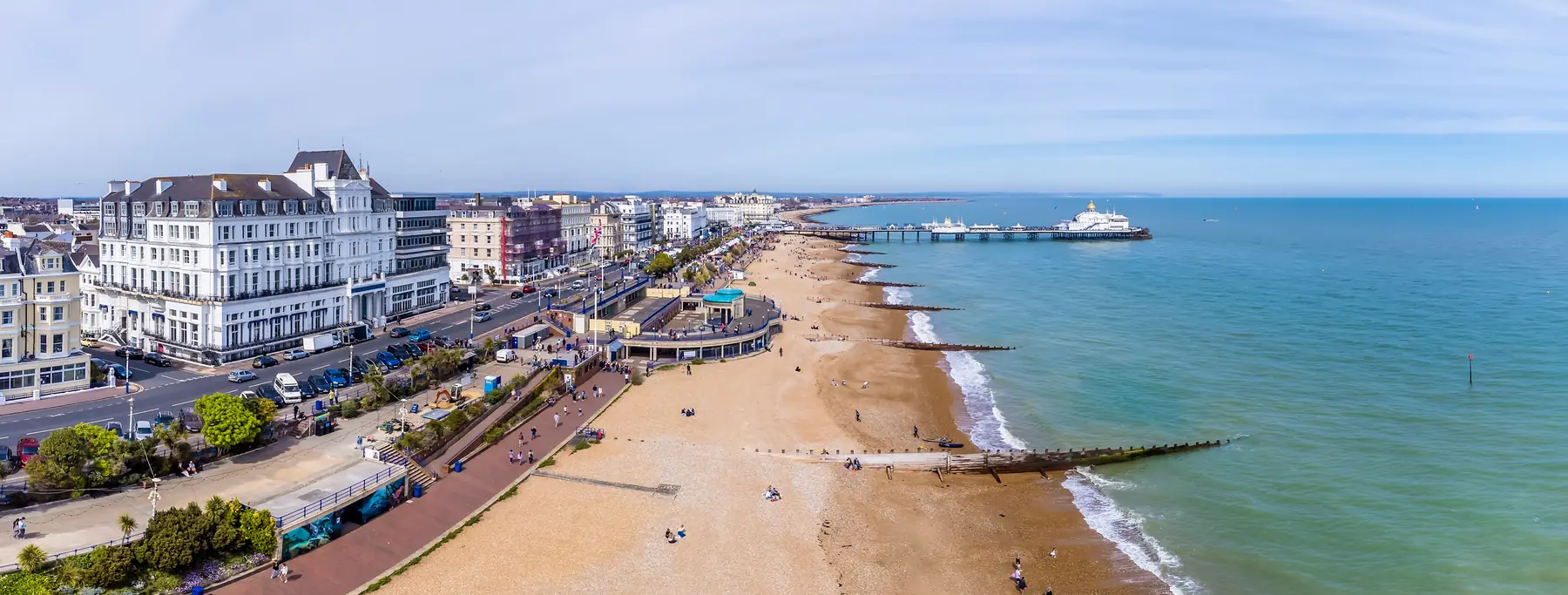
Eastbourne is one of the better English resorts for spending very little. The seafront was deliberately kept free of commercial development by the Devonshire estate, which means the promenade is a Victorian one of hotels and gardens rather than arcades; the town’s art gallery is free and genuinely good; the beach is free; and the greatest single sight in the area — the chalk cliffs running west from the town — costs nothing at all.
The town’s art gallery, free to enter, holding one of the most significant public collections in the south-east. The Ravilious holdings are the highlight and are exactly the right thing to look at before or after walking the Downs he painted. There are contemporary exhibitions, a café and a building wrapped in a large-scale mural. It is the best free thing in Eastbourne by a distance.
Six kilometres of level promenade from Sovereign Harbour to Holywell, with the 1935 bandstand halfway along, the Wish Tower Martello tower on the western section, the Redoubt fortress at the eastern end, the Carpet Gardens opposite the pier and a long series of shelters and benches. The seafront concerts at the bandstand are ticketed, but a great deal of the music carries perfectly well to the free deckchairs behind.
Free to walk onto, and a proper Victorian pier. The arcades and food are not free, but the walk out over the water is.
Shingle at the top with sand exposed at low tide, and it runs the whole length of the town. Holywell at the western end, under the cliffs, is the quietest stretch.
Princes Park — thirty-three acres east of the centre with a boating lake and lawns. Hampden Park — a large park north of the town with woodland and a lake. Gildredge Park in the Old Town, and Helen Garden on the western seafront. All free.
A fifteen-minute walk inland, Eastbourne’s Old Town is the village the resort was built next to — a parish church, some flint cottages, a couple of good pubs and none of the Victorian grandeur. It is free, quiet and missed by nearly everyone.
This is where the free things become extraordinary.
Beachy Head, five kilometres west, is the highest chalk sea cliff in Britain and open access land — you can walk the whole clifftop for nothing, with the lighthouse below and the Downs behind. Birling Gap has a National Trust visitor centre and steps to the beach; walking and the beach are free, parking is not.
The Seven Sisters run west from Birling Gap to Cuckmere Haven, six kilometres of chalk headlands, all of it open and free.
Cuckmere Haven and the Seven Sisters Country Park at Exceat give a flat walk down a river valley to an undeveloped beach.
The South Downs Way starts in Eastbourne and runs 160 kilometres west. The first stretch to Alfriston is free walking of the highest quality.
The Long Man of Wilmington, ten kilometres north-west, is a seventy-metre chalk figure on a hillside, free to walk up to.
Our walks guide covers all of these.
The Pevensey Levels are a national nature reserve of drained marsh and dykes with free access, big skies and very few people. Pevensey Bay and the shingle coast east to the Martello towers are free, as is looking at the outside of Pevensey Castle — though going inside is not.
Airbourne, in mid-August, is the town’s biggest event and the largest free air display on the south coast: four days of flying over the sea, with the Red Arrows a regular fixture, plus ground events and live music. It costs nothing to watch from the seafront, and the town is correspondingly full — book accommodation months ahead.
Beyond it, the bandstand programme, the seafront in general, and a busy calendar of markets, fairs and community events keep the free options topped up through the year.
Worth checking before you pay twice. Birling Gap and the Seven Sisters and the Alfriston Clergy House are National Trust; Pevensey Castle and Battle Abbey are English Heritage. If you hold either membership the area becomes considerably cheaper, and the car parking at Birling Gap in particular is where it pays.
Parking is the main cost, as usual. The good news is that Eastbourne has more genuinely free parking than most resorts: the Enterprise Shopping Centre, Trinity Place, Fishermen’s Green, the Redoubt and the Sovereign Park car parks are all free, and up on the Downland so are Heathy Brow and Warren Hill, which are the ones you want for Beachy Head.
Better still, the station is in the middle of town and the buses along the seafront and out to the cliffs are frequent, including an open-top service in summer. Eastbourne is easy to do without a car.
Start at the Towner when it opens. Walk down to the seafront and west along the promenade past the Wish Tower to Holywell, then climb onto the Downland and out to Beachy Head — an hour and a half with the whole coast opening up behind you. Take lunch on the clifftop. Walk on to Birling Gap and down the steps to the beach, then catch the bus back along the cliff road into town. Finish on the pier as the light goes.
That is one of the best days on the south coast, and it costs a bus fare.
The single biggest free asset here is the open access land west of the town. The Eastbourne Downland Estate — several thousand acres of chalk grassland running from the edge of the town out over Beachy Head — is owned by the borough and open to walk on. That is unusual: most great coastal landscapes in England are either private, ticketed or National Trust car park by default.
What it means in practice is that you can walk out of your accommodation in Eastbourne, climb onto the Downs, and spend an entire day on some of the best coastal walking in Britain without passing a till. Add the bus back along the cliff road and you have a full day out for a couple of pounds.
Airbourne in mid-August is the headline. Beyond it: the seafront and Carpet Gardens are free year-round; the bandstand’s paid concerts are audible from the free seating behind; the town runs markets, fairs and community events through the season; and the tennis at Devonshire Park in June fills the town with an atmosphere you can enjoy without a ticket.
Winter is quieter but the promenade, the Towner and the Downs do not close, and Eastbourne on a bright January day with the cliffs white in the low sun is as good as it gets here.
Fifteen minutes inland from the seafront is the village Eastbourne was before the Dukes of Devonshire built a resort next to it, and almost no visitors go there. St Mary’s parish church is largely twelfth-century, the Lamb Inn beside it is medieval in parts, and the streets around them are flint and brick rather than Victorian stucco.
It costs nothing to walk round, it takes an hour, and it is the best short answer to anyone who says Eastbourne is all Victorian hotels. Gildredge Park, on the way there from the town centre, is free and has the Towner at the edge of it.
Yes, general entry is free.
Yes, it is open access downland. Only the car parks charge, and the ones up on the Downland at Heathy Brow and Warren Hill are free.
Yes — it is the largest free air display on the south coast, over four days in mid-August.
More than in most resorts: the shopping centre, Trinity Place, Fishermen’s Green, the Redoubt and Sovereign Park are all free.
The beach, the promenade, Princes Park’s lawns, Hampden Park and the rock pools at Birling Gap at low tide.